

Understanding Peer-to-Peer Systems in Kenya's Digital Economy
Explore how peer-to-peer (P2P) systems boost Kenya's digital economy 🇰🇪, from P2P lending to file sharing, enhancing financial inclusion and entrepreneurship 📱💼.
Edited By
Richard Dawson
The logarithm function often appears in financial models and data analysis where growth rates and compound interest calculations matter. Knowing how to derive the logarithm is key for traders, investors, and financial analysts looking to understand rate changes or perform optimisation in algorithms.
The derivative of the logarithm function measures its rate of change and plays a crucial role in calculus applications tied to economics and finance. For instance, when modelling the continuous growth of an investment, the natural logarithm (log base e) frequently comes into play.
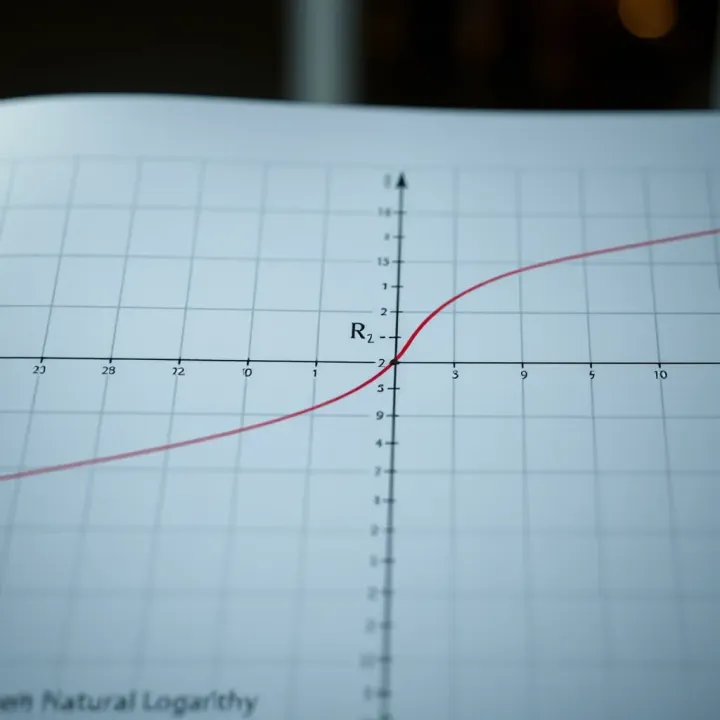
Before jumping into derivation, it's helpful to recall what logarithms are. A logarithm answers the question: to what power must the base be raised to produce a given number? For example, log base 10 of 100 is 2, since 10 squared equals 100.
There are two main cases for logarithms in practice:
Natural logarithm (ln), which uses base e (approx. 2.718)
Logarithms with other bases, like base 10 or base 2
Each case requires a slightly different approach to differentiation due to their base differences.
Calculating the derivative of logarithms means finding how fast the logarithm value changes as its input grows. This helps in optimising financial functions and analysing data trends.
In this section, we focus mostly on the natural logarithm because it offers a smoother path to derivation, widely used in financial formulas and continuous compounding calculations. We then summarise how to extend the approach to other bases.
Here is what you’ll learn:
Definition and key properties of logarithms impacting derivatives
Step-by-step method to differentiate the natural logarithm
How to handle logarithms with different bases
Practical examples relevant to trading and investment analysis
Understanding these points lays the foundation that helps you confidently apply logarithm derivatives in real-world financial problems.
Next, we will look into the natural logarithm derivative and how it simplifies many calculations in the financial sector.
Understanding the basics of logarithm functions sets a strong foundation for anyone dealing with derivatives in finance and economics. Logarithms simplify complex multiplicative relationships into additive ones, which is crucial when analysing exponential growth in investments or decay in asset values. Getting these fundamentals right saves time when approaching derivative calculations later.
A logarithm answers the question: to what power must you raise a base to get a certain number? Formally, for a positive number b (not equal to 1) and x > 0, the logarithm base b of x is the exponent y such that b^y = x. For example, if you know that 10 raised to the power of 3 is 1,000, then log base 10 of 1,000 is 3.
This definition is practical in financial settings where exponential growth is common. For instance, understanding how many years it takes for capital to grow given a certain interest rate requires working with logarithms directly.
Logarithms and exponents are two sides of the same coin. An exponent shows repeated multiplication, while a logarithm reveals the power applied. They invert each other's operation. This relationship is handy when modelling compound interest or decay because you can switch from exponential to linear scales for analysis.
For example, if you track the doubling of money every certain period, exponents tell you the amount after a fixed time, while logarithms help you determine the time required for the money to reach a target sum.
The natural logarithm uses the mathematical constant e (~2.718) as its base. It appears frequently in continuous growth models like population growth or continuously compounded interest rates often encountered in finance. The natural log simplifies differentiation and integration in calculus, making it particularly relevant when dealing with derivatives.
For example, if a stock price follows continuous compounding, then the natural logarithm helps find the growth rate or price changes efficiently.
Base 10 logarithms, often called common logarithms, are widely used in scientific calculations and data that span large ranges, such as sound intensity or pH levels. In finance, log base 10 can help simplify analysis of data scaled over several orders of magnitude but is less common in continuous models.
Other bases may also appear based on context, such as binary logs (base 2) in computer science. While the mechanics are similar, the choice of base affects how derivatives behave, which is why converting all logarithms to natural logs is standard before differentiation.
Remember: mastering logarithm basics makes it easier to work with their derivatives later, which impacts financial modelling, risk analysis, and economic forecasting.
Logarithms convert multiplication into addition.
They are inverses of exponential functions.
Natural logs link closely to continuous growth.
Changing bases helps standardise differentiation techniques.
Understanding the core rules of differentiation is vital when working with logarithmic functions. In finance, trading, or economics, log functions often model exponential growth or decay, so knowing how to find their derivatives helps in analysing rates of change effectively. This section covers the basics needed to handle differentiation involving logs confidently.
Differentiation of constants and variables: Differentiation is straightforward when it comes to simple constants and variables. The derivative of a constant, like a fixed interest rate or a set fee (e.g., KS00), is always zero because constants don't change. On the other hand, the derivative of a variable such as time or price is usually one, reflecting its direct rate of change. For example, when you differentiate the function f(x) = 5, the result is zero, but for f(x) = x, the derivative is one. This fundamental understanding sets the stage for handling more complex functions.
Applying the chain rule: This rule is crucial when differentiating composite functions — functions inside another function — which often occurs with logarithms. The chain rule says you differentiate the outer function first, then multiply by the derivative of the inner function. In practical terms, if you have a function like ln(3x), you first differentiate ln(u) with respect to u, then multiply by the derivative of u = 3x. This approach allows traders and analysts to break down complicated movements and understand underlying rates in layered financial models.
Why and how the chain rule is used: Logarithmic functions rarely appear as simple standalone expressions in real-world finance; they usually involve variables inside their argument. For instance, ln(2t + 5) requires applying the chain rule. You differentiate ln(u) as 1/u, then multiply by the derivative of u = 2t + 5, which is 2. This technique is especially useful when modelling growth that depends on multiple factors, enabling clearer insight into how each variable affects the overall rate.
Knowing when and how to apply the chain rule ensures accuracy in differentiating complex log-based models, which is essential in precise risk management and forecasting.
Role of implicit differentiation when necessary: Sometimes, logarithmic expressions cannot be rearranged cleanly to separate y and x, especially in equations like ln(y) + y = x. Here, implicit differentiation helps by differentiating both sides with respect to x, treating y as a function of x. This method uncovers the derivative of y even when it is embedded implicitly, allowing analysts to derive relationships between variables that are not explicitly solved. For financial experts handling such scenarios, implicit differentiation offers a powerful tool to unravel hidden dynamics.
In summary, mastering these differentiation principles equips you with the toolkit needed to handle logarithmic functions in financial modelling, making your analysis sharper and more reliable.
Understanding how to derive the natural logarithm function (ln) is essential for traders, investors, and financial analysts because it appears frequently in growth models, interest calculations, and risk assessments. The natural logarithm relates directly to exponential functions with base e (approximately 2.718), which model continuous growth—a common scenario in finance and economics. Grasping its derivative allows you to analyse rates of change in portfolios, pricing models, or economic indicators where ln(x) shows up.
The natural logarithm ln(x) is the inverse of the exponential function e^x. This means if y = ln(x), then e^y = x. This inversion is useful because it enables us to express ln(x) through exponentials, which are easier to differentiate. In practical terms, this relationship underpins calculations in continuous compounding and options pricing.
Rewriting ln(x) with this definition allows us to explore its properties through known derivatives of exponential functions. Because many real-world financial models use continuous compounding, being able to differentiate ln helps in understanding how quickly an investment grows over time.
Using the formal definition of a derivative, the derivative of ln(x) is found by evaluating the limit:
math
By applying logarithm properties (difference of logs becomes a log of the quotient), this expression simplifies to:

```math
With substitution and application of the limit, the derivative resolves to 1/x. This limit approach clarifies the behaviour of the ln function and why its slope depends inversely on x, which is crucial for modelling changing growth rates or elasticity in economic contexts.
The derivative of ln(x), 1/x, arises because small changes in x produce inversely proportional changes in ln(x). For example, when x is large, a small increase barely affects ln(x), indicating a slow rate of change, while near zero, ln(x) changes rapidly.
In finance, this explains why returns or rates scale differently depending on the underlying quantity. Say, in a stock price model, the relative change is tied to the ln derivative reflecting percentage variations rather than absolute.
The ln function only applies to positive values of x because the logarithm of zero or negative numbers is undefined in real numbers. This means the derivative 1/x only makes sense for x > 0.
For financial analysts, this restricts certain calculations. For instance, you can’t model logarithmic returns for zero or negative asset prices. When working with datasets or models, make sure inputs fall within the valid domain to avoid errors or misleading results.
By understanding these concrete steps and restrictions, you can confidently apply ln derivatives to various financial and economic problems, ensuring both accuracy and relevance in your analysis.
Understanding how to derive logarithms with different bases plays a key role in financial analysis and trading where logarithmic models often involve bases other than the natural number e. Knowing the derivative of these logarithms helps when dealing with exponential growth rates in investments, currency exchange modelling, or risk analysis. The formula and method used lets you adjust differentiation to match the specific logarithm base relevant to your problem, ensuring accuracy.
A crucial step in differentiating logarithms with any base is converting them to the natural logarithm, ln, using the change of base formula. This formula states that for any positive a (not equal to 1), and x, the logarithm base a of x can be rewritten:
This is particularly useful because the derivative of _ln(x)_ is well-known and easy to handle. Instead of tackling the derivative of an uncommon log base directly, you transform the problem into one involving natural logarithms. This trick simplifies your work and reduces errors in more complex calculations.

Rewriting a logarithm in terms of the natural log also helps when using software tools or programming environments, as _ln_ functions are commonly built-in. So, whether you’re modelling compound interest or pricing derivatives that follow base 10 or base 2 logs, converting them to _ln_ keeps things manageable.

### Derivative Formula for Logarithm Base a

Once _log_a(x)_ is rewritten in terms of _ln_, differentiating becomes straightforward. Using the chain rule and the constant multiple rule, the derivative formula is:
Here, _ln(a)_ is treated as a constant depending on the base, and the derivative behaves like that of the natural log but scaled accordingly. This general formula applies whether the base is 2, 10, or any other positive number, making it adaptable.

### Examples Using Log Base  and Others

Take the common logarithm base 10, often used in financial calculations like pH scales or decibel levels. Its derivative with respect to _x_ is:
Since _ln(10)_ is approximately 2.3026, this factor adjusts the rate of change compared to the natural logarithm.

Similarly, for base 2 logs, common in algorithms and data processing, the derivative is:
Knowing these formulas lets financial analysts and fintech developers differentiate functions accurately when dealing with logarithms in various bases. This precision has practical benefits, such as calculating marginal growth rates or optimising algorithm performance based on logarithmic complexity.

> Knowing how to convert any log base derivative into a simple formula using natural logs gives you flexibility and precision — essential for financial maths and data models.


## Practical Examples and Applications

Practical examples help bridge the gap between theory and actual use, especially for those working in finance, trading, or economic analysis. Understanding how to differentiate logarithmic functions allows you to better model real-life situations, such as price changes or risk evaluation. Applying these concepts to concrete problems sharpens insight and equips you to make smarter, data-driven decisions.

### Differentiating Functions Involving Logarithms

#### Simple cases like ln(3x) or log5(x²)

When differentiating simple logarithmic expressions such as \( \ln(3x) \) or \( \log_5(x^2) \), the process relies on the chain rule and the basic derivatives of logarithms. For example, \( \fracddx \ln(3x) = \frac13x \times 3 = \frac1x \). The constants pull through straightforwardly, which makes handling growth models or scaling factors in financial functions simpler.


#### More complex functions using the chain rule

More involved functions—like \( \ln(5x^3 + 2x) \)—demand a careful application of the chain rule. Here, differentiating involves two steps: take the derivative of the logarithm and multiply by the derivative of the inner function. So, \[ \fracddx \ln(5x^3 + 2x) = \frac15x^3 + 2x \times (15x^2 + 2) \]. This approach works well in modelling non-linear growth patterns or when you want to find the sensitivity of certain financial instruments to changes in multiple variables.

Using this approach improves accuracy in forecasting models and economic reports where variables interact in complex ways, enhancing your ability to interpret shifts in market data or risk factors.

### Applications in Real-world Problems

#### Growth and decay models

Logarithmic derivatives frequently appear in growth and decay models, which are common in economics and sciences. For instance, in modelling population growth or loan amortisation, the rate of change of a quantity often depends on the natural logarithm of some variable.

Take a bacterial culture growing according to the function \( P(t) = P_0 e^kt \), where \( k \) is the growth rate. By taking logarithms, differentiating, and then solving, you get insights on how fast the population increases over time. This helps investors understand compound returns or traders forecast asset growth trends.

#### Calculating rates in economics and sciences

In economics, logarithmic derivatives can calculate elasticity of demand, which measures how sensitive demand is when prices change. If \( Q = aP^b \) (quantity depends on price), then logarithmic differentiation tells us that the elasticity is \( b \), the exponent on price. This method simplifies complicated formulas, making it easier to estimate how demand will respond to price changes.

Scientists use logarithmic differentiation for reaction rates and half-life calculations. Getting these derivatives right means you can predict how variables like concentration or temperature affect reaction speeds, which has practical uses in pharmaceuticals, agriculture, and environmental science.

> **Remember:** mastering these examples allows you to better interpret the maths behind financial and scientific data, making your analysis both practical and robust.Explore how peer-to-peer (P2P) systems boost Kenya's digital economy 🇰🇪, from P2P lending to file sharing, enhancing financial inclusion and entrepreneurship 📱💼.

📈 Explore Tradeview Deriv’s trading tools, forex and CFDs options, account types, and safety features to trade confidently in Kenya’s growing online market.

📊 Master forex trading with this detailed guide designed for Kenyan traders. Learn market basics, smart strategies, risk control, and pick the best forex course to trade confidently.

📈 Learn to spot forex chart patterns with handy PDFs to sharpen trading skills. A clear, practical guide tailored for Kenyan traders to boost smart trading decisions.
Based on 8 reviews